
Oklahoma County Previous Residents Sources
Different Oklahoma County records answer different parts of the address question. The Assessor provides a current parcel lead, while the County Clerk preserves the recorded instruments that transfer an interest in land. Old directories can place a household or business at an address in a particular year. Census material and newspapers can then help distinguish people with the same name. A deed does not establish who occupied a property, and a directory entry does not prove ownership. Treat each source as a dated piece of the trail rather than a complete answer about who lived here before.
| Source | Years It Covers | Where Held | What It Shows |
|---|---|---|---|
| County Clerk land instruments | Early patents through present, online cutoff not located | County Clerk and ROD/UCC portal | Recorded deeds, liens, plats, and party roles |
| Assessor parcel file | Current database, start year not located | Oklahoma County Assessor | Owner label, legal description, values, and deed-table leads |
| OHS city directories | Annual issues, full run not located | Oklahoma History Research Center | Address, household clues, and historical listings |
| Federal and territorial census | Federal releases follow the 72-year rule | NARA and Oklahoma Historical Society | Historical household and locality context |
| OKC permit records | Records stated back to 1983 | Oklahoma City Citizen Access | Address-linked work and filing chronology |
For a recent transfer, begin with the parcel and recorded instrument. For an older household question, set a directory year beside the census release that is available, then look for an obituary, probate index, or newspaper notice only after the address and date match. Oklahoma City permits are a useful side trail when the question is about a change to a building, not a claim about its occupants.
Note: Write down the exact address form, legal description, source title, repository, and date before moving to the next record.
Oklahoma County Deed Record Chain
The Oklahoma County Assessor property search is a fast starting point for an address. Its parcel card can show the situs address, owner label, PIN, addition, block, lot, and a deed-transaction table. The situs is the physical location, while a billing address is where tax correspondence goes. Neither is proof that a particular person is present at the property. Use the parcel information to search the County Clerk ROD/UCC portal, where a recorded instrument can verify the transfer and identify its grantor and grantee.
The Oklahoma County Clerk is the Registrar of Deeds and describes its holdings as extending from early federal patents through territorial records and the present. Newly recorded instruments may take time to appear online, and some records or fields can be redacted. When an online result is incomplete, the Clerk office is the next route for the instrument, a copy request, or confirmation of the current access path.
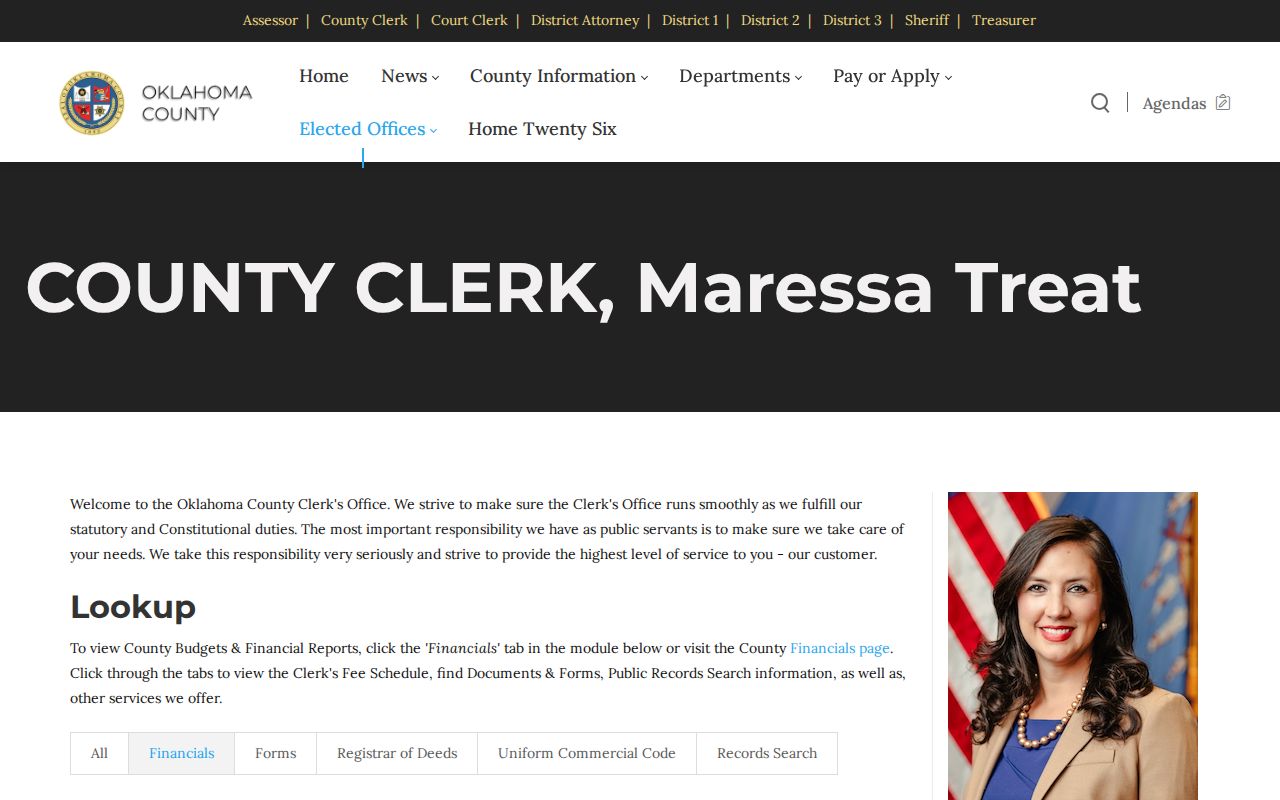
The Clerk route is where a parcel lead becomes a dated deed search, rather than an assumption about a past household.
- Search the address or owner in the Assessor file and record the PIN, legal description, deed book, page, and transaction date shown.
- Locate the current owner’s acquisition in the Clerk index by party, book and page, instrument type, or approximate recording date.
- Read the earlier seller as the grantor on that instrument, then search that name as grantee for the prior acquisition.
- Repeat the backward handoff, preserving every recording date and document reference instead of guessing from a sale price.
- Ask the Clerk about office copies or older volumes when the online sequence stops, since the portal’s indexed-year cutoff was not located.
- Grantor and grantee
- The grantor transfers an interest. The grantee receives that interest in the recorded instrument.
- Chain of title
- A dated sequence of conveyances for one parcel, verified from the actual recorded instruments.
- Legal description
- The addition, block, lot, or land description used to identify the parcel when street names or numbers change.
Oklahoma County House-History Route
The Assessor and Clerk give the land-record side of a house history. The Oklahoma Historical Society recommends adding directories, maps, newspapers, and neighborhood histories to that work. Copy the subdivision or legal description before leaving the parcel record. It can remain stable when an address is renumbered or a street is renamed. Keep the original source beside any later transcription. The County warns that its GIS display is not a legal survey and that the Clerk deed controls the legal description.
The Assessor search screen accepts name, physical address, account, subdivision, block, lot, map number, deed book and page, and occupant or building-name fields. The owner search is surname-first, ignores punctuation, and supports selected wildcard searches. An occupant field can be blank or limited, so it should not be read as a list of every resident.
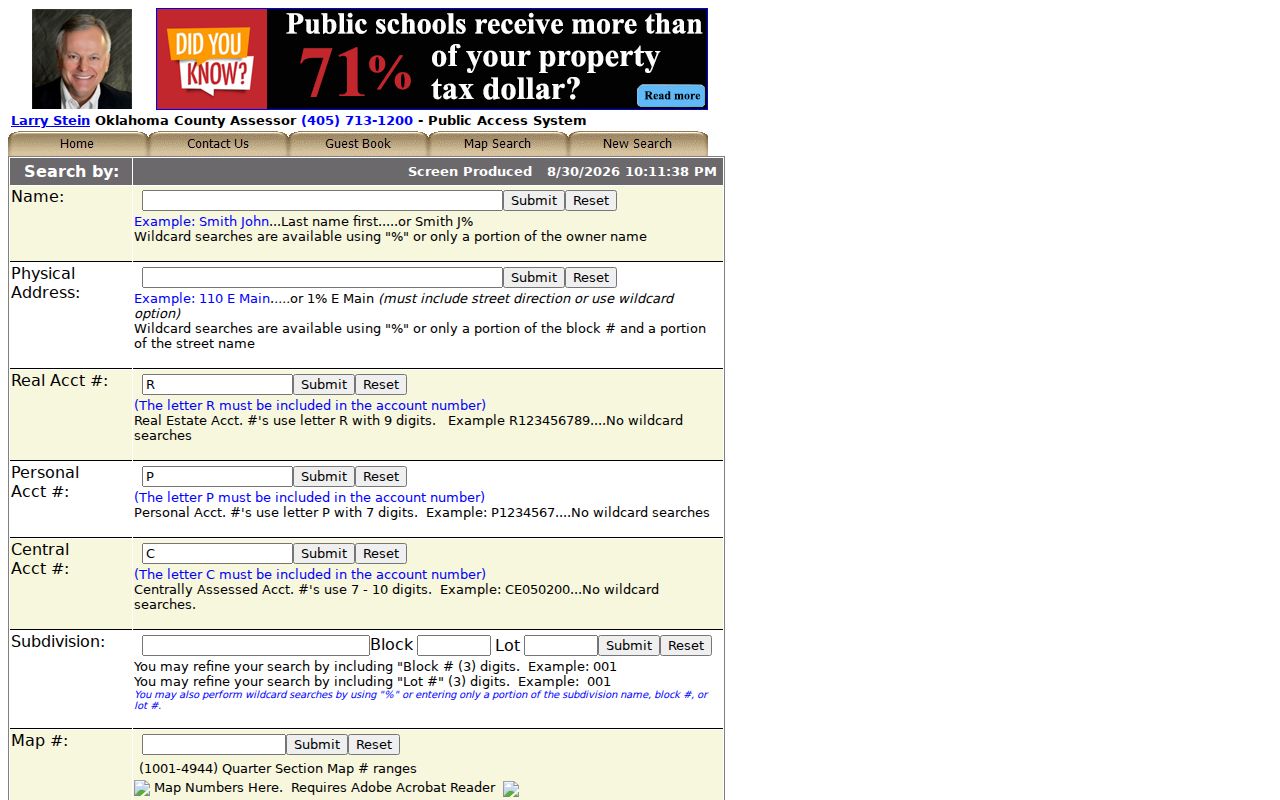
Those address and parcel fields provide a repeatable way to connect a modern location to a documented land-record lead.
The Oklahoma Historical Society home-history guide places that parcel work in a wider sequence: assessor, deed records, city directories, Sanborn maps, newspapers, and neighborhood publications. Its Research Center route is important when a source is not digitized. A catalog hit or directory index is a lead, not a substitute for the dated page, reel, or original item.
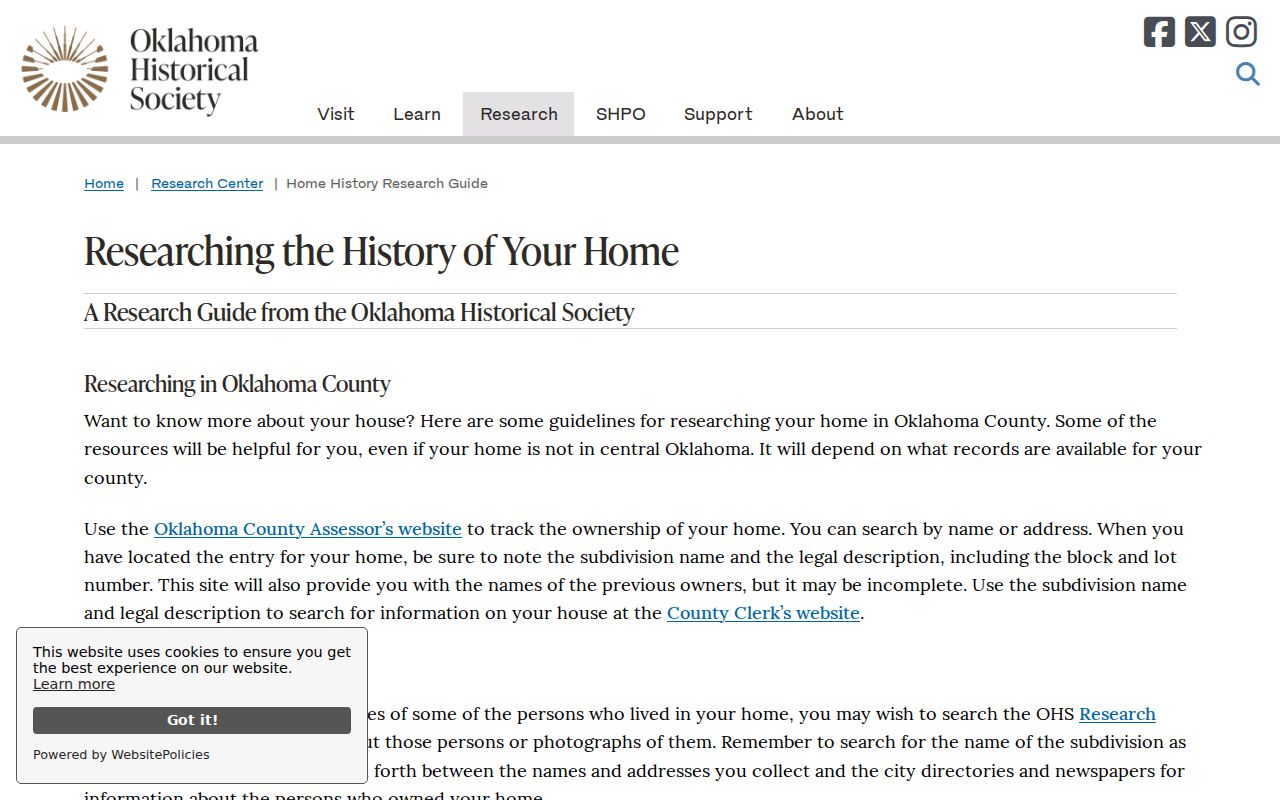
The home-history sequence keeps the land record, the address, and the historical household evidence in their proper roles.
Oklahoma County Historic Address Names
Old street wording can decide whether a search succeeds. The Historical Society’s downtown survey records several changes, including NW 3rd becoming Dean A. McGee after 1975 and NW 2nd becoming Robert S Kerr between 1955 and 1964. Older records can also spell a direction out rather than use an abbreviation. Search both the present name and the earlier form, then compare the block, addition, and directory year before joining the results. This is a geography check, not evidence that the old and new labels always describe the same parcel.
Digitized newspapers often preserve the street wording used at the time. Gateway to Oklahoma History can be searched by title, date, page, person, or address terms. Use both the street number and a spelled-out directional variant, then keep the archive citation with the item.
A dated newspaper result can support a timeline, but it still needs to be read with the directory and property record for the same era.
Oklahoma County Previous Residents Directories
Directories help answer the occupant side of the question. The Oklahoma History Research Center’s city-directory search has City and Year fields, and the collection may include a name, address, profession, spouse notation, agency listing, or business category. Access to the directory materials requires a Research Center visit. Exact coverage for every annual issue and reverse-directory run was not located, so verify the year, format, page, and abbreviation key before treating an entry as a household match. The collections themselves are described in the Oklahoma County directory book.
Pair an address trail with census material only when the street, locality, and time fit. Federal census releases follow a 72-year rule, and the federal 1890 census was destroyed. The Oklahoma Historical Society holds a 1890 Oklahoma Territorial Census, which is a useful local source but not a complete replacement for the federal schedule. A directory supplies an address-year lead; the census supplies a separately dated household record. They should agree before names are connected.
Work from an address-year lead toward the separately dated household source. Keep unresolved names apart rather than merging them because they appear near the same block.
- Record the directory title, year, page, address wording, and any abbreviation key used for the entry.
- Locate the released census material for the matching locality and compare the address, names, and household timing.
- Test historic street-name variants in newspapers, maps, and later directory years when the address does not align.
- Stop the match when two same-name people cannot be separated by address and date.
Oklahoma County Archive Endpoints
Older Oklahoma County trails sometimes end in an index rather than an image. OHS offers Oklahoma City death-index material for 1908 through 1926, Oklahoma County divorce indexing for 1923 through 1944, and probate indexing for 1890 through 1928. A result can supply a date, source code, party name, or legal clue, but the underlying item may need a copy request, fee, or Research Center visit. Probate is especially useful for an estate question because it can point to a court file rather than a general household list.
The Metropolitan Library genealogy resources and OHS collections also supply newspapers, yearbooks, telephone books, local histories, and research help. When an online lead fails, ask the repository which shelf, microfilm, scan, or request route applies to the exact year. That preserves the county’s offline and appointment-based access channels instead of treating the web index as the whole archive.
Note: Preserve the source title, page or image number, repository, and coverage statement with every historical address finding.
Oklahoma County Permit Trails
Address-based permits can add a dated building-history clue after the deed and directory work is complete. Oklahoma City Citizen Access allows searches by permit number, type, application name, date, site address, direction, street, ZIP, and unit. The city states that records reach back to 1983, while the default display emphasizes the most recent twelve years. A permit can show a filing or alteration chronology. It does not establish who lived at the address, who paid for the work, or who was present after the work ended.
For a record outside the portal view, use the city’s records-request process with the exact address, date range, permit type if known, preferred delivery format, and a fee ceiling. That request route is more reliable than treating a blank online result as proof that no older record exists.
Oklahoma County Past Households
Previous residents research is strongest when it stays focused on a documented address and time period. Parcel ownership, a tax mailing field, a directory listing, and a newspaper mention serve different purposes. They cannot prove family relationships, current presence, or a complete household. Recent vital records have separate eligibility limits, while historical indexes have their own coverage gaps. For a missing record, use the custodian, repository, or Oklahoma Open Records Act request route rather than trying to assemble protected information from unrelated systems.
Lawful use. Use Oklahoma County house-history and family-history records for personal, lawful research. Do not use an address trail to watch, harass, intimidate, or harm any person.