
Locate Oklahoma County City Directory Collections
Oklahoma County historical directory research centers on Oklahoma City holdings. The Oklahoma Historical Society Research Center holds city directories, telephone books, yearbooks, census material, club records, newspapers, and several county indexes. Its directory search accepts a city and a year, but the results page says access requires a Research Center visit. The researched record does not establish a complete continuous online run, so a year that does not appear in an online search should be checked with staff or the catalog instead of treated as missing.
| Collection | Years | Where held | Access |
|---|---|---|---|
| Smith's First Directory of Oklahoma Territory | 1890 | OHS Research Center microfilm and catalog route | Verify at the Research Center |
| Oklahoma City and County Directory | 1900-1901 | OHS land-record and local-history holdings | Confirm shelf and format with OHS |
| Warden-Hoffine, Warden-Ebright, and Warden's Official directories | Exact runs not located | OHS microfilm archive guide | Research Center verification |
| Oklahoma City directories near 1930 | 1929-1932 | National Archives directory resource | National Archives access route |
| Telephone and reverse directories | Exact local runs not located | OHS and Metropolitan Library collections | Verify years and onsite format |
The table marks known anchors, not a promise that every year between them survives. OHS describes its issues as annual, while the exact year range, scan status, and reverse-directory run were not located in the official review. Record the title as printed, then save the repository and page number with every Oklahoma County directory finding.
Note: A catalog hit, index result, and original directory volume are different access levels, so identify which one supplied each fact.
Search Oklahoma County City Directory Issues
The OHS city-directory search is the direct starting point for a city and year. The official description says a directory can include names, addresses, occupations or professions, agencies, and categorical business listings. It is useful for narrowing a request, but it does not replace reading the page. The same person may be listed surname first, under initials, at a former street name, or only in a business or agency section.
The OHS city-directory search shown below is the source image used for Oklahoma County city directory research.
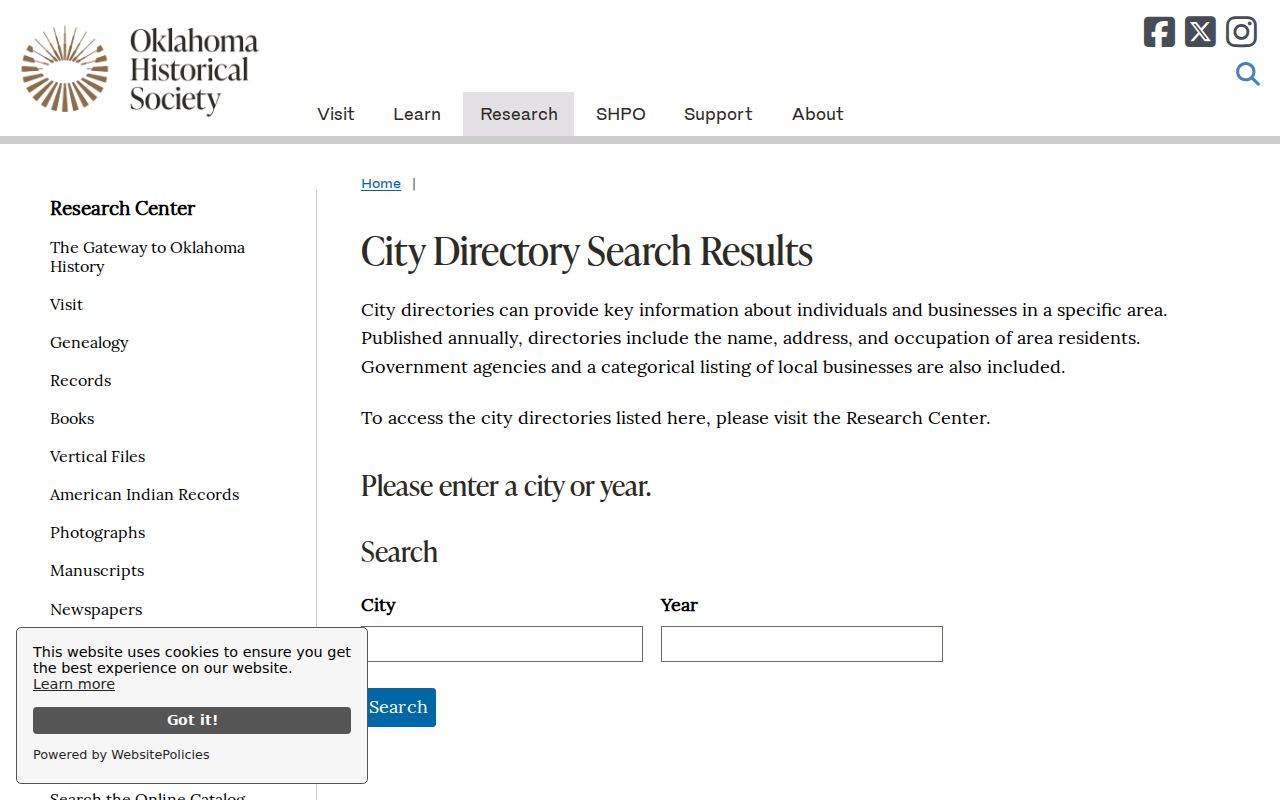
Use the city and year as a pointer, then visit the Research Center when the result requires onsite access. Bring name variants and likely street spellings. OHS's home-history guidance also recommends spelling out a direction such as “northwest” as well as trying “NW” in older materials and newspaper searches.
Metropolitan Library and Oklahoma County City Directories
The Metropolitan Library genealogy service adds local print material, yearbooks, census indexes, family histories, and historic newspaper resources to a directory search. Its Ronald J. Norick Library and Special Collections route is especially useful when a directory name needs a school, family, or newspaper cross-check. Some online newspaper products may require a library card or onsite use, so availability should be confirmed with the library rather than assumed from a search result.
The Metropolitan Library genealogy resources shown here are a companion to, not a substitute for, the dated directory volume.
For a former classmate or a family-history question, yearbooks and historic newspapers can connect a directory address to a dated mention. They remain historical leads. A yearbook entry cannot establish current identity or present residence.
Read an Oklahoma County City Directory Entry
A directory entry is compact. Read each field against the volume's own abbreviation key, because the official inspection did not expose a scanned Oklahoma City entry or a publisher-specific key. The details below are the inventory supported by OHS collection guidance. A mark that looks like ownership or occupancy must be checked in that issue before it is described as such.
| Person name | Usually a surname-first form, sometimes with initials or a spouse clue. |
|---|---|
| Household clue | A spouse in parentheses or widow notation may appear, but conventions vary by volume. |
| Address | Street and number, which may use an earlier directional or street-name form. |
| Occupation or profession | A historical affiliation field, not a statement about a present credential. |
| Owner or occupancy mark | Possible in address or business conventions; verify it against the issue's key. |
| Source citation | Directory year, page, publisher or title, and repository. |
- Criss-cross directory
- A reverse section arranged by address or street, used to find an historical occupant or business from a location.
- Householder index
- A list organized around the household name rather than a subject index; it can separate similar surnames by address.
- Abbreviation key
- The volume's own explanation of shortened words and symbols. Photograph or note it before interpreting a listing.
Neighbor and owner indicators may appear in a back section or reverse listing, but a directory is still an index-like lead. A deed, census page, or requested record is the next source when a historical conclusion needs stronger support.
Map Oklahoma County City Directory Gaps
Oklahoma City's record story has useful markers, but it also has real gaps. The official record does not give a last printed directory year or a publisher-by-year sequence. The safest timeline identifies only the dates the repositories actually name. That prevents a searcher from turning several well-known books into a false claim of uninterrupted coverage.
- 1890: Smith's First Directory of Oklahoma Territory is a named OHS collection anchor.
- 1900-1901: Oklahoma City and County Directory is identified through OHS history and land-record guidance.
- Later issues: OHS microfilm guidance names Warden-Hoffine, Warden-Ebright, and Warden's Official Oklahoma City Directory titles, without a verified complete run.
- 1929-1932: the National Archives directory resource identifies Oklahoma City coverage near the 1930 census.
- Current access: OHS provides city-and-year discovery, while the physical format of each item should be confirmed before a visit.
The OHS microfilm archive guide is a useful preparation tool. Where a title or year is not confirmed, ask staff about the catalog entry, microfilm availability, copy procedure, and any visit requirements. Do not fill an unknown year with a neighboring edition.
Note: A missing web result may reflect an onsite-only record, an unindexed issue, or an unverified run, not the absence of a household.
Trace an Oklahoma County City Directory Household
Start a household trail with the earliest confirmed name and address, then move one directory issue at a time. The goal is to create a dated sequence, not to force all similar names into one person. Pairing issues with census years often makes a move, a spouse clue, or a changed occupation easier to test. For a modern address question, the separate Oklahoma County street directory route is better suited to address-keyed county records.
- Locate a person under surname-first, initial, and historical-spelling variations in one confirmed year.
- Copy the complete entry and its citation, including directory title, year, page, and repository.
- Check the next available issue for the same address, spouse clue, occupation, or agency listing.
- Use a criss-cross or reverse section only when the actual run and key have been verified.
- Pair the directory sequence with the closest released census, newspaper notice, obituary, probate index, or recorded instrument.
A disappearance can mean a move, death, a name variation, a changed listing convention, or a missing issue. The OHS home-history guide recommends combining directories with assessor and deed records, Sanborn maps, newspapers, and neighborhood histories. That approach keeps a household narrative tied to records rather than assumption.
Link Oklahoma County City Directories to 1890
Early Oklahoma City research benefits from a local substitute for a national gap. The federal 1890 census was destroyed, while OHS holds a 1890 Oklahoma Territorial Census. It is not a complete replacement for the federal schedule, but it can be paired with Smith's 1890 directory, land-run material, and later city directories. The combination gives a more careful way to follow early residents through a fast-changing place.
The OHS research holdings shown below bring directories together with territorial census, land-run certificates, probate, divorce, newspapers, and local-history materials.
Oklahoma City incorporated as a four-ward village in 1890, and Oklahoma County 2 was organized that year. Those dates explain why 1890 records deserve close source labels. A territorial listing, a directory listing, and a final-certificate record each answer different questions about a person and place.
Use Death and Obituary Indexes Carefully
When a household trail ends, the OHS Oklahoma City death index can supply a historical lead for deaths from 1908 through 1926, with directory notices for 1918 and 1920 through 1923. Its fields can include death and birth details, marital status, parents, occupation, physician, cemetery, and undertaker. Those fields are unusually helpful for distinguishing two people with the same name.
The OHS death-index screen shown here is an index route, not a certificate or a current resident record.
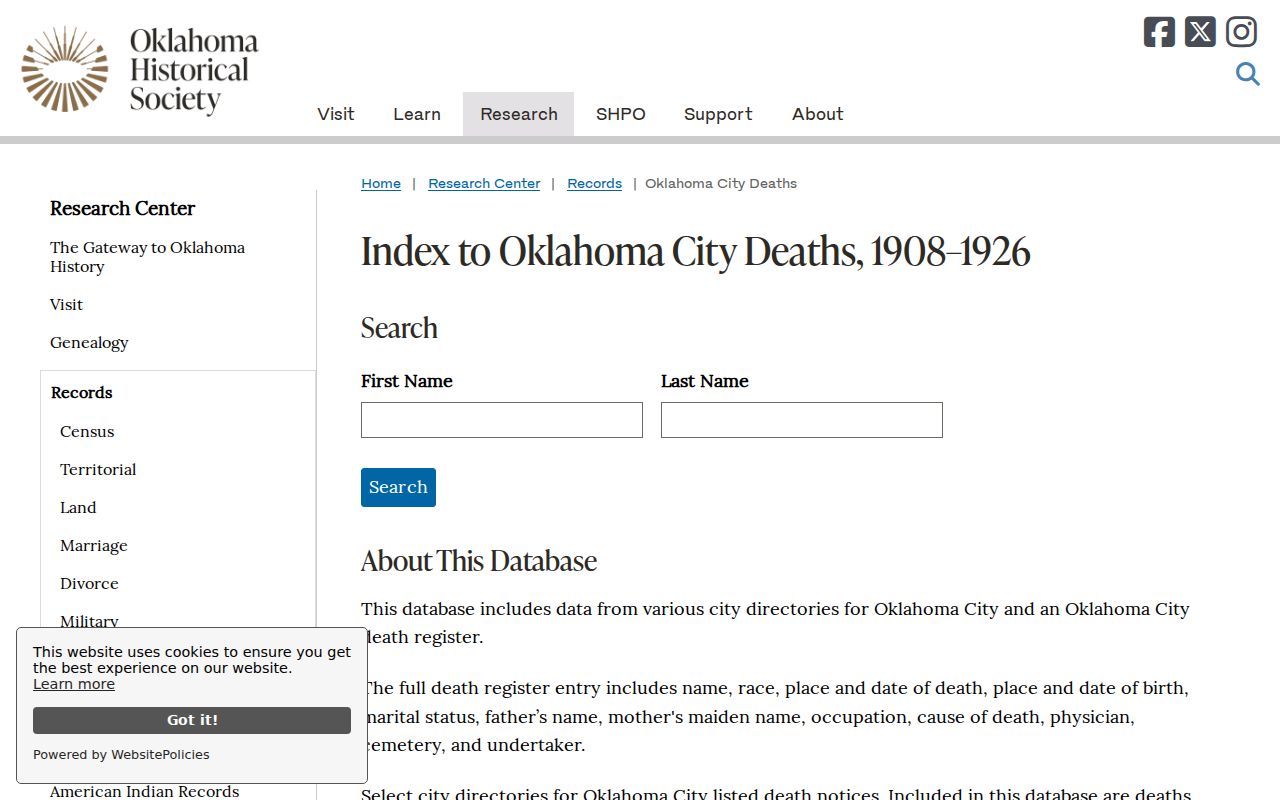
OHS also lists Oklahoman obituaries for 1972 through 2014 and funeral-home records or programs for 1905 through 2020. Confirm an item by its date, title, page, and repository. An index result may lead to a request, a copy fee, or a Research Center visit before the underlying material can be reviewed.
Note: A historical death, obituary, or directory entry supports a dated research lead and should never be used to infer current identity.
Cite Each Oklahoma County Historical Source
Keep a short citation log: repository, exact title, year or coverage, page or image, access mode, and date checked. This matters when a name appears in an OHS index but the original lives on microfilm, or when a newspaper item comes through the Gateway to Oklahoma History. A link alone is not enough to recreate a result after a catalog or interface changes.
For materials outside the directory shelf, the Oklahoma City archives route uses appointment and research-request procedures, and the State Archives can hold transferred state series. Contact either repository before travel. Library card, onsite, staff-request, microfilm, archive appointment, and copy-request access are separate channels that should be recorded with the item.